

How To Draw Syntactic Trees For Subjunctive Mood
Morphology & Dependency Copse
The analyzeSyntax method returns details about the linguistic structure of the given text. For each token in the text, the Natural language API provides information most its internal construction (morphology) and its office in the sentence (syntax).
Morphology is the study of the internal structure of words.. Morphology focuses on how the components inside a word (stems, root words, prefixes, suffixes, etc.) are arranged or modified to create different meanings. English, for case, frequently adds "-s" or "-es" to the end of count nouns to indicate plurality, and a "-d" or "-ed" to a verb to point by tense. The suffix "-ly" is added to adjectives to create adverbs (for case, "happy" [adjective] and "happily" [adverb]).
The Natural Linguistic communication API uses morphological analysis to infer grammatical information near words.
Morphology varies greatly between languages. In languages such as Russian, discussion endings point the function of a word in a judgement (for example, "книга" [book - nominative case] becomes "книгу" [accusative case] when it's the straight object of a verb). This means word society tin can vary without changing the pregnant of the judgement, though different word order does impact contextual appropriateness. Languages such as English language and Mandarin, which both lack affixes indicating case, rely more on the word order in a sentence to indicate the respective roles of words. Every bit a result, morphological analysis depends heavily on the source language, and an agreement of what is supported within that language.
Syntax is the report of the structure of phrases and sentences. Syntax and morphology work together to signal grammatical relationships, with different languages dividing the labor between them differently. For case, Russian uses an affix to indicate the office of direct object ("у" in "книгу"), whereas English uses give-and-take order, where the straight object follows the verb (read the book).
The analyzeSyntax response returns morphological information in the partOfSpeech field and the syntactic relationship between words in the dependencyTree field.
Parts of Speech
Inside a syntactic request, office-of-oral communication and morphological data are returned within the response's partOfSpeech field. The partOfSpeech field contains a set of sub-fields with Part-of-Speech (POS) information every bit well as more explicit morphological information. These subfields are listed below.
-
tagdenotes the part of speech using a coarse-grained POS tag (Substantive, VERB, etc.), and provides pinnacle-level surface syntax information. POS tags are helpful if y'all want to create patterns and/or reduce ambiguity for subsequent linguistic communication analysis (for example, "train" tagged as a Noun versus a VERB). -
numberdenotes a word's grammatical number. In English, the suffix "-s" is added to count nouns to indicate more than one (for example, "dog+s" indicates more than 1 dog). Absence of the plural suffix is ofttimes referred to every bit the singular form. Some languages, such equally Arabic, have the notion of a dual number as well. This field may incorporate the following values:-
SINGULARdenotes ane quantity. -
PLURALdenotes more i quantity. -
DUALdenotes precisely two quantities.
-
-
personidentifies a discussion's grammatical person. In English language, "I/me" is 1st person singular and references the speaker (or author) of the expression, whereas "you" and "she/her and he/him" reference the intended addressee (hearer) and some other person, respectively. This field may incorporate the following values:-
FIRSTperson denotes the speaker. -
SECONDperson denotes intended addressee, that is, the person spoken to. -
Thirdperson denotes non-speaker/not-hearer. -
REFLEXIVE_PERSONindicates, for case, the subject and the object reference the aforementioned entity, as in "The cat licked itself," where -self attaches to a pronoun to bespeak reflexivity. In Russian and Japanese, the reflexive is a standalone pronoun. (for example, "John loves himself" in Russian is "Джон любит себя" where себя is gender neutral "self"; in Japanese it's "Tarō wa zibun o aisuru" (Romanized version) where "zibun" is gender neutral "self." Meet reflexive pronoun.
-
-
genderdenotes a noun's grammatical gender. This field may incorporate the following values:- The
FEMININEgrammatical gender - The
MASCULINEgrammatical gender - The
NEUTERgrammatical gender
- The
-
casedenotes a word's grammatical case and its role in a phrase or judgement. This field may contain the following values::- The
ACCUSATIVEexample indicates the direct object of a transitive verb. - The
ADVERBIALinstance indicates an adverbial course of an adjective. Notation that English uses separate words adverbs ("well") and adjectives ("good"). The suffix -ly in English does derive adverbs from adjectives (for example, "happy," "happily"), though information technology's not considered a "example". - The
COMPLEMENTIVEcase (Chinese) indicates a discussion necessary to complete the significant of a potential, descriptive, or resultative expression using a conjunctive particle. - The
DATIVEcase indicates an indirect object, which refers to the referent receiving the direct object. In English language, the indirect object is often indicated by the preposition "to" as in the phrase "He gave the ball to Bobby," where "Bobby" is the indirect object, and is the recipient of the ball. Whereas in this Russian case: Иван дал книгу маше (Ivan gave the volume to Masha), "-due east" indicates "маше" is the indirect object, and Masha is the recipient of the volume. - The
GENITIVEcase indicates possession. Note that English oftentimes indicates possession using the "-'s" affix instead of using a genitive example. The "-'south" braze can can attach to the end of a phrase (for example, "[The human who ran the bill up]'south wife paid a dear price for his excess."). Whereas in this Russian example, "-а" marks "Антон-" as genitive: "Где книга Антона?" (Where is Anton's book). In Russian, the genitive example also shows up every bit the complement of words similar "several," "few." For example: Зимой здесь мало снега ("In winter there is piffling snowfall here") "-a" marks "снег-" (snow) as genitive, since it is the complement of "мало" ("piffling"). There is no possession involved. - The
INSTRUMENTALcase indicates whether a substantive is the instrument by which an action is completed. In Russian, the English sentence, "He opened the door with a cardinal," would be: "он открыл дверь ключом" where "-om" attaches to "ключ" (key) indicating instrumental example. - The
LOCATIVEcase indicates a word's use to refer to a location. English language, does not have a locative case. - The
NOMINATIVEinstance is associated with the discipline of a verb. In English, the subject of a sentence is indicated through word order, not case. In the sentence, "The daughter won the race," the phrase "the girl" is the bailiwick, appearing to the left of the verb, "won." In Russian, девушка (the/a girl) tin announced either before or after the verb: "девушка выиграла гонку" or "гонку выиграла девушка", where the verb is выиграла (won). - The
OBLIQUEinstance indicates a word's utilise as an object to either a verb or preposition. - The
PARTITIVEcase indicates a word's "partialness" or lack of specific identity. An case of a partitive in English would exist "3 of my friends." In Russian, this would exist "трое моих друзей" where "трое" is "three of" (compare with "три друга" where "три" is "three"). - The
PREPOSITIONALcase indicates the object of a preposition. - The
REFLEXIVE_CASEindicates the identity of an object of a verb to its subject area. Virtually languages do not use a reflexive case, every bit this usage is indicated through utilize of special reflexive pronouns instead (such equally "himself", "myself", etc.") - The
RELATIVE_CASE(Chinese) indicates the complementizer of a relative clause connecting a noun with a verb or describing word. Examples: 工作 [的] 地方 (work [] place :: "place [where I] work"). 便宜 的 餐馆 (inexpensive [] restaurants :: restaurants [that are] inexpensive). - The
VOCATIVEcase indicates a noun existence used to accost someone or something, commonly when spoken to.
- The
-
tensedenotes a verb's grammatical tense, which indicates the verb's reference to a position in time. Note thattenseis distinct fromaspect, which besides deals with a verb'south relationship to fourth dimension, but focuses on the characteristics of that time menses, rather than its position. TheIMPERFECTandPLUPERFECTtenses in many languages more than accurately refer to specific combinations of tense and attribute. This field may contain the following values:-
CONDITIONAL_TENSEis an alternate term for the more prevalent morphological term of "conditional mood." (SeeCONDITIONAL_MOODbelow.) -
Futuritydenotes an activity taking place in the future. Note that in English, the future tense is well-nigh often denoted by adding the word "will" to a verb phrase. -
PASTdenotes an action taking place in the past. -
PRESENTdenotes an action taking identify in the present. -
IMPERFECTdenotes an activity taking place in the past, but which was not completed at that tense's frame of reference. Note that in English language, the imperfect tense is most ofttimes denoted past adding a gerund class of a verb to the by tense every bit in "I was walking." An imperfect tense result takes place in the past, simply is not completed relative to that past tense. -
PLUPERFECTdenotes an action that has taken place in the past, and was also completed at that tense's frame of reference. For instance, "I had walked" takes place in the past, but was also consummate during the by tense's frame of reference.
-
-
aspectdenotes a verb's grammatical aspect, its expression of time flow. Unliketense, which focuses on a verb's position within time,aspectfocuses on the characteristics of that time menstruation where it occurs. This field may contain the post-obit values:- The
PERFECTIVEattribute denotes an event that is "completed" either because information technology has completely happened in the by or will completely happen in the future. - The
IMPERFECTIVEaspect denotes an event that is incomplete, either because it is continuous or because it is repeated. - The
PROGRESSIVEaspect denotes an upshot that is continuous. A progressive aspect is generally treated equally a special case of the more full general imperfective attribute (which also covers repetition).
- The
-
mooddenotes a verb's grammatical mood, which indicates attitude near an underlying activity. This field may contain the following values:-
CONDITIONAL_MOODindicates an activity which is contingent. Note that in English, verb forms are not provisional; instead, conditional behavior is noted through employ of the give-and-take "would" combined with the verb's infinitive. -
IMPERATIVEindicates a command or request through the second person. -
INDICATIVEindicates a statement of fact, more mostly known as a "realis mood." -
INTERROGATIVEindicates a question. -
JUSSIVEindicates a command or request through either the get-go or third person. English does non have a jussive mood, though exhortations that begin with a existent or unsaid "Let us" convey this jussive mood. -
SUBJUNCTIVEindicates a quality of uncertainty related to an action, besides known equally an "irrealis" mood (contrasted with the "realis" indicative mood). English does not have a specific subjunctive mood; instead, words such as "want", "wish", "hope", etc. convey the import of the subjunctive mood.
-
-
voxdenotes a verb'southward grammatical vocalism, the human relationship between an action and a subject and/or object. This field may contain the post-obit values:-
ACTIVEvoice indicates an action whose subject is performing the action. -
CAUSATIVEvocalization indicates an action whose outcome is existence performed on the subject. In English, no straight causative voice exists; instead, such causation is indicated through employ of the verb "make", every bit in "Mom made me go to school." -
PASSIVEvoice indicates an activity whose outcome is being performed on the subject. In many cases, a passive "agent" is unspoken or unknown.
-
-
reciprocitydenotes a give-and-take's (typically a pronoun's) reciprocity, indicating the pronoun refers to a substantive phrase elsewhere inside the judgement. This field may contain the following values:-
RECIPROCALindicates the pronoun is reciprocal. -
NON_RECIPROCALindicates the pronoun is not reciprocal.
-
-
properdenotes whether a noun is function of a proper name. Note that many proper names consist of several words; if this phrase is detected as a proper proper noun, each token will be detected every bit proper equally well. (For example, both "Wrigley" and "Field" in the proper name "Wrigley Field" volition accept their proper attribute fix toPROPER. This field may contain the following values:-
PROPERdenotes that the token is part of a proper name. -
NOT_PROPERdenotes that the token is not part of a name.
-
-
classdenotes boosted morphological forms that don't neatly fit into the previous set of mutual forms (tense,mood,person, etc.) Almost of these forms are specific to unique languages. This field may contain the following values:-
ADNOMIAL(Korean/Japanese) indicates a word ending (Korean) or verb (Japanese) that modifies a noun phrase. Examples: 밥을 먹는 사람 [someone who eats rice] and 書く人 [someone who writes]. -
AUXILIARY(Korean) indicates a word ending that connects 2 adjacent master and auxiliary predicates: 밥을 먹게 하다 [brand (someone) to eat] -
COMPLEMENTIZER(Korean) indicates a discussion ending that connects two or more different clauses: 밥을 먹고 물을 마신다 [ (I) eat rice and potable water] -
FINAL_ENDING(Korean/Japanese) indicates a word catastrophe that finalizes the clause or sentence coming at the stop of the clause or judgement. Examples: 밥을 먹는다 [(I) eat rice] and 手紙を書く [write a letter]. -
GERUND(Korean/Japanese) indicates a discussion ending that nominalizes verbs or adjectives: (Korean) 밥 먹기 [eating rice] or connects verbs with various auxiliary verbs: (Japanese) 書きたい [desire to write] -
REALIS(Japanese) indicates conditional and subjunctive forms with a conjunctive particle "ば": 書けば [if (I) write]. -
IRREALIS(Japanese) indicates connecting verbs with negative, passive, or causative auxiliary verbs: 書かない [do not write], 書かれる [to exist written], 書かせる [make (someone) write]. -
ORDER(Japanese) indicates a command verb, similar to imperitive: 書け! [write!] -
SPECIFIC(Japanese) indicates special forms that cannot be covered past the six categories to a higher place. The almost common use of this form is a derivation of a substantive from an adjective by calculation a suffix to the grade: かわいさ [cuteness] -
Curt(Russian) indicates a brusk-course adjective or participle. -
LONG(Russian) indicates a long-form adjective or participle, as singled-out from the aboveBruskform.
-
Note that the Natural Linguistic communication API provides morphological information on a per-token ground (not per phrase). Morphological constructs that cross discussion boundaries may non be supported.
Dependency trees
Inside a syntactic request, function-of-speech and morphological information are returned within the response's partOfSpeech field.
For each judgement inside the text provided to the Natural Language API for syntactic assay, the API constructs a dependency tree that describes the syntactic structure of that judgement. The syntactic information are returned within the response's dependencyEdge field.
A diagram of the dependency tree for this single sentence from John F. Kennedy's Inaugural speech communication appears below:
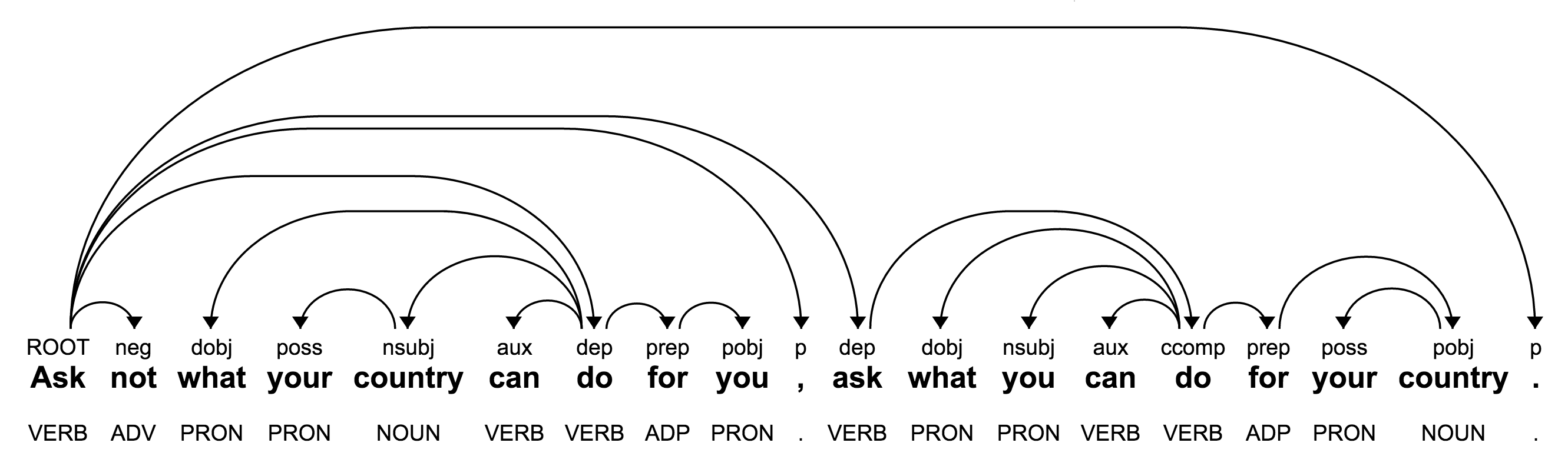
For each token, the dependencyEdge chemical element identifies which other token it modifies (in the headTokenIndex field) and the syntactic human relationship between this token and its head token (in the label field). For example, hither is the dependencyEdge element for the token "your" in (the first occurrence of) the phrase "your country":
"dependencyEdge": { "headTokenIndex": 4, "label": "POSS" }, This element indicates that "your" modifies the fifth token (headTokenIndex uses a zero-based showtime) and that it is a possessive modifier.
Every dependency tree includes a ROOT element ("label": ROOT), which corresponds to the primary verb in the sentence. In the above example, the ROOT chemical element happens to be the first word in the sentence ("headTokenIndex": 0). For the ROOT word "Inquire", the headTokenIndex is its own index.
Although parse trees practice non cross judgement boundaries, the Natural Language API indexes sentences and tokens using zero-based offset values within the text as a whole.
The Tongue API labels syntactic relationships using a common set up of dependencies that apply across the supported languages. The labels are described beneath. In example text, "Head" and the label appear below the tokens to which they apply.
| Label | Description |
|---|---|
UNKNOWN | Unknown human relationship |
ABBREV | An abbreviation of the caput token.British Broadcasting Company (BBC) Head ABBREV |
ACOMP | An adjectival phrase that functions as a complement (similar an object of the verb). This relation specifically includes `exist` copula constructions with adjective predicates. The book looks heavy. Head ACOMP The volume is heavy. Head ACOMPThe tag also applies to non-statement adjective adjuncts and in raising constructions with adjectival predicates. She arrived distressing. Head ACOMP I consider John intelligent. Head ACOMP |
ADVCL | An adverbial clause modifying a verb, such as a temporal clause, upshot, conditional clause, or purpose clause.The accident happened as the nighttime was falling. Head ADVCL If y'all know who did it, you lot should tell the instructor. ADVCL Head He talked to him in order to secure the account. Head ADVCL |
ADVPHMOD | Adverbial phrase modifier (Japanese) |
ADVMOD | A (non-clausal) adverb or adverbial phrase that serves to modify the significant of a word.Genetically modified nutrient. ADVMOD Caput less often ADVMOD Head About 200 people came to the party. ADVMOD Head |
AMOD | An adjectival phrase that serves to modify the pregnant of a noun phrase.Sam eats ruby-red meat. AMOD Caput Sam took out a three one thousand thousand dollar loan. AMOD Head |
APPOS | A noun phrase immediately to the correct of another noun phrase, with the second phrase serving to define or modify the first.Sam, my blood brother, arrived. Head APPOS Bill (John's cousin) Head APPOS |
ATTR | A nominal phrase headed past a copular verb. Note that ``ATTR`` is unlike from ``ACOMP`` in that the dependent is a noun phrase, not an adjective.He is a doctor. Head ATTR She resembles her female parent. Caput ATTRIn questions, the wh-pronoun or the substantive in the wh-phrase is in the ``ATTR`` relation to the ``ROOT``. What is your name? ATTR Caput NSUBJ What breed is the dog? ATTR Head NSUBJRaising constructions with nominal predicates also use the ``ATTR`` relation. I consider John an intelligent person. Caput ATTR |
AUX | A non-main verb, such as a modal auxiliary or a form of ``be``, ``do``, or ``accept`` in a periphrastic tense. Excludes the utilise of ``exist`` as an auxiliary in a passive construction.Reagan has died. AUX Head He should leave. AUX Caput |
AUXPASS | A not-main verb of a clause in the passive voice.Kennedy has been killed. AUX AUXPASS Head Kennedy was/got killed. AUXPASS Head |
CC | The relation between an element of a conjunct and the coordinating conjunction. One conjunct of a conjunction (commonly the first) is treated as the head of the conjunction.Nib is big and honest. Caput CC They either ski or snowboard. Head CC Bill went to Florida but Jane traveled to Alaska. Caput CC |
CCOMP | A dependent clause with an internal subject that functions like an object of the verb or adjective.He says that you similar to swim. Caput CCOMP I am certain that he did it. Head CCOMP I admire the fact that you lot are honest. Head CCOMP |
CONJ | The relation between two elements connected by a coordinating conjunction, such every bit ``and`` or ``or``. The head of the relation is the get-go conjunct and other conjunctions depend on it via the ``conj`` relation.Bill is big and honest. Head CONJ They either ski or snowboard. Head CONJ We take apples, pears, oranges, and bananas. DOBJ CONJ CONJ CONJ |
CSUBJ | A clausal syntactic subject of a clause; that is, the subject is itself a clause ("What she said" in the example below).What she said makes sense. CSUBJ Head |
CSUBJPASS | A clausal syntactic subject of a passive clause.That she lied was suspected by everyone. CSUBJ Head |
DEP | The arrangement is unable to determine a more than precise dependency relation between 2 words.Then, as if to show that he could, . . . DEP Head travel agency florence kentucky Head DEP |
DET | The relation between the head of a noun phrase and its determiner.The homo is hither. DET Head Which book do you prefer? DET Head |
Soapbox | Interjections and other soapbox elements that are not conspicuously linked to the construction of the sentence, except in an expressive mode. Examples are interjections (``'oh'``, ``'uh-huh'``, ``'Welcome'``), fillers (``'um'``, ``'ah'``), and discourse markers (``'well'``, ``'like'``, ``'actually'``, only not ``'you know'``).Iguazu is in Argentina :) Caput Soapbox |
DOBJ | The noun phrase that is the ([accusative](https://en.wikipedia.org/wiki/Accusative_case)) object of a verb.She gave me a raise. Head DOBJ They win the lottery. Head DOBJ |
EXPL | Pleonastic nominal. In English, this is some uses of ``it`` and ``there``: the existential ``in that location``, and ``it`` when used in extraposition constructions. An expletive or pleonastic nominal is one where the nominal does not satisfy a semantic role of the predicate. In languages with expletives, they can be positioned in the subject and direct object slots.There is a ghost in the room. EXPL Head NSUBJ It is clear that nosotros should reject. EXPL Caput |
GOESWITH | Links two parts of a word that are separated in text. |
IOBJ | The noun phrase that is the ([dative](https://en.wikipedia.org/wiki/Dative_case)) indirect object of a verb.She gave me a present. Head IOBJ DOBJ |
Marking | The word introducing a finite or non-finite subordinate clause, such every bit ``'that'`` or ``'whether'``. The head is the caput of the subordinate clause.Forces engaged in fighting after insurgents attacked. MARK Head He says that y'all like to swim. MARK Head |
MWE | Ane of the two relations (alongside ``NN``) for compounding. Information technology is used for certain fixed grammaticized expressions with function words that behave like a unmarried function discussion. Multiword expressions are annotated in a apartment, head-initial construction, in which all words in the expression alter the kickoff one using the ``MWE`` label.I like dogs equally well as cats. Caput MWE MWE He cried because of you lot. Head MWE |
MWV | Multi-discussion exact expression. |
NEG | The relation between a negation discussion and the give-and-take it modifies.Bill is non a scientist. Head NEG Pecker is no scientist. NEG Head |
NN | Any substantive that serves to change the head noun.phone book NN Head oil price futures NN NN Head |
NPADVMOD | A noun phrase used as an adverbial modifier.The manager is 65 years old. NPADVMOD Head 6 anxiety long NPADVMOD Head Shares eased a fraction. Head NPADVMOD The silence is itself significant. NPADVMOD Head 90% of Australians like him, the virtually of whatever land. Head NPADVMOD |
NSUBJ | A noun phrase that is the syntactic subject of a clause.Clinton defeated Dole. NSUBJ Head The baby is beautiful NSUBJ Head |
NSUBJPASS | A noun phrase that is the syntactic subject of a passive clause.Dole was defeated by Clinton. NSUBJPASS Head |
NUM | Whatever number phrase that serves to modify the meaning of the noun with a quantity.Sam ate three sheep. NUM Caput |
NUMBER | Office of a number phrase.I have iv g sheep. NUMBER Caput |
P | Any slice of punctuation in a clause. |
PARATAXIS | The parataxis relation (from Greek for "identify side by side") is a relation between a give-and-take (oft the principal predicate of a sentence) and other elements placed adjacent without whatever explicit coordination, subordination, or statement relation with the head word. Parataxis is a discourse-like equivalent of coordination.Let's face up it we're annoyed. Head PARATAXIS The guy, John said, left early on in the forenoon. PARATAXIS Head |
PARTMOD | Participial modifier |
PCOMP | Used when the complement of a preposition is a clause or prepositional phrase (or occasionally, an adverbial phrase).We have no data on whether users are at hazard. Head PCOMP They heard about you missing classes. Head PCOMP |
POBJ | The head of a noun phrase following a preposition or the adverbs ``'here'`` and ``'there'``.I saturday on the chair. Head POBJ What does CPR stand up for? POBJ Caput |
POSS | A possessive determiner or [genitive](https://en.wikipedia.org/wiki/Genitive_case) modifier.their offices POSS Head Bill's clothes. POSS Head |
POSTNEG | Postverbal negative particle |
PRECOMP | Predicate complement |
PRECONJ | A word that appears at the start bracketing a conjunction, such every bit ``'either'``, ``'both'``, ``'neither'``).Both the boys and the girls are here. PRECONJ Caput |
PREDET | A discussion that precedes and modifies the meaning of a noun phrase determiner.All the boys are hither. PREDET Caput |
PREF | Prefix |
PREP | Whatever prepositional phrase that serves to modify the pregnant of a verb, describing word, substantive, or even another preposition.I saw a cat in a hat. Head PREP I saw a cat with a telescope. Caput PREP He is responsible for meals. Head PREP |
PRONL | The human relationship between a verb and verbal morpheme (French) |
PRT | A verb particle.They shut down the station. Head PRT He would not put up with information technology. Head PRT |
PS | Associative or possessive marker |
QUANTMOD | Quantifier phrase modifier |
RCMOD | A link from a substantive to the verb which heads a relative clause.I saw the man yous love. Head RCMOD the book that you bought Head RCMOD Bong, a visitor which is based in LA, makes and distributes computer products. Head RCMOD |
RCMODREL | Complementizer in relative clause (Chinese) |
RDROP | Ellipsis without a preceding predicate (Japanese) |
REF | Referent (Hindi) |
REMNANT | Used for ellipsis.John won statuary, Mary silver, and Sandy aureate. Head REMNANT REMNANT |
REPARANDUM | Indicates disfluencies overridden in a speech communication repair.Become to the righ- to the left. REPARANDUM Caput |
ROOT | The root of the sentence. In vast majority of cases it is a verb. |
SNUM | Suffix specifying a unit of number(Japanese) |
SUFF | Suffix |
TMOD | A bare substantive phrase elective that serves to modify the pregnant of the elective by specifying a time. ``TMOD`` captures temporal points and duration; it does not capture repetition (``'two times'``, which would be an ``'NPADVMOD'``).Last night, I swam in the pool. TMOD Head |
TOPIC | Topic marker (Chinese) |
VMOD | A clause headed by an space form of the verb.Berries gathered on this side of the mountain are sweeter. Head VMOD He sat in the armchair reading the morning newspaper. Head VMOD I have nothing to say to them. Head VMOD |
VOCATIVE | Marks a dialogue participant addressed in text (common in emails and newsgroup postings).Anna, can you bring a tent? VOCATIVE Head |
XCOMP | A clausal complement without its own subject, whose reference is determined by an external discipline.He says that you similar to swim. Caput XCOMP I am ready to go out. Head XCOMP |
SUFFIX | Name suffix |
TITLE | Proper name title |
AUXCAUS | Causative auxiliary (Japanese) |
AUXVV | Helper auxiliary (Japanese) |
DTMOD | Rentaishi (Prenominal modifier) |
Foreign | Foreign words |
KW | Keyword |
LIST | List for chains of comparable items |
NOMC | Nominalized clause |
NOMCSUBJ | Nominalized clausal subject |
NOMCSUBJPASS | Nominalized clausal passive |
NUMC | Compound of numeric modifier (Japanese) |
COP | Copula (Spanish) |
DISLOCATED | Dislocated relation (for fronted/topicalized elements) |
ASP | Attribute marking |
GMOD | Genitive modifier |
GOBJ | Genitive object |
INFMOD | Infinitival modifier |
MES | Measure out |
NCOMP | Nominal complement of a noun |
For more information about dependency trees, consult the Universal Dependency Treebank project. In add-on, Universal Dependency Annotation for Multilingual Processing contains groundwork data on the methodology used to interpret such a dependency tree.
Parsing a syntactic assay response
The following pseudo-code provides a mutual pattern to use when performing iterative operations on the syntactic analysis response:
alphabetize = 0 for sentence in self.sentences: content = sentence['text']['content'] sentence_begin = judgement['text']['beginOffset'] sentence_end = sentence_begin + len(content) - 1 while index < len(self.tokens) and cocky.tokens[index]['text']['beginOffset'] <= sentence_end: # This token is in this sentence index += 1
Except as otherwise noted, the content of this page is licensed nether the Creative Commons Attribution 4.0 License, and code samples are licensed under the Apache 2.0 License. For details, see the Google Developers Site Policies. Java is a registered trademark of Oracle and/or its affiliates.
Last updated 2022-02-ten UTC.

Source: https://cloud.google.com/natural-language/docs/morphology
Posted by: claussenmades1969.blogspot.com
0 Response to "How To Draw Syntactic Trees For Subjunctive Mood"
Post a Comment